Digital News Portal
Breaking News TodayViral NewsTrending TopicsLatest UpdatesCelebrity NewsTechnology News
Skip linksSkip to Content
Live
Navigation menu
  • News
    • Africa
    • Asia
    • US & Canada
    • Latin America
    • Europe
    • Asia Pacific
  • Middle East
  • Explained
  • Opinion
  • Sport
  • Video
    • Features
    • Economy
    • Human Rights
    • Climate Crisis
    • Investigations
    • Interactives
    • In Pictures
    • Science & Technology
    • Podcasts
    • Travel
play
Live

In Pictures

Gallery|Arts and Culture

Palestinian learns to make recycled art in prison

A young Palestinian pays his way through university selling recycled art he learned to make while in an Israeli prison.

Save

Share

facebookxwhatsapp-strokecopylink
Palestinian artists /Please Do Not Use
Ghassan al-Azzeh finishes off the portraits in a variety of ways, but his favourite seems to be rolling the tops and bottoms of a portrait with slender wooden poles and turning them into hanging scrolls. [Abed al Qaisi/Al Jazeera]
By Sheren Khalel
Published On 14 Jun 201614 Jun 2016

Bethlehem, Occupied West Bank – Ghassan al-Azzeh was arrested by Israeli occupation forces and sent to prison when he was only 16 years old. As a young teen in an adult detention facility, al-Azzeh was lost until a group of older artists, also Palestinians imprisoned by Israel, took him in.

Al-Azzeh was interested in art before he was arrested, but did not take the craft seriously until it became his only reprieve from the daily life of prison.

“They taught me so much about making art in prison. We didn’t have real art materials, so they showed me how to make brown sugar packets into beautiful portraits,” al-Azzeh said from his cramped backyard workshop in Beit Jibrin refugee camp.

“This rock,” he said, picking up a stone half the size of his calloused palm, “would have been a treasure in the prison. The guys taught me how to make all of kinds of things from carving a rock like this.”

Al-Azzeh was released from prison three years later, but did not forget his craft. Once back in the real world, the young man continued to make art from recycled material.

“I like to take recycled things and make them into something new. Art can be a way of resistance – it’s my way of resistance,” he said.

In addition to his political artwork, al-Azzeh has also taken to making polished furniture out of pallet wood found throughout the city.

His most recent project, a desk for one of his professors at Birzeit University, sat half finished on the back porch of his home. The dark stain and polished wood of the desk had been smoothed down so artfully it was difficult to imagine the piece was crafted from scrap pallets like those stacked up on the side of his narrow workshop.

Advertisement

Al-Azzeh commissions art by word-of-mouth as well as a Facebook group called Made in Camp. His work has been fruitful enough to help him pay the off his tuition fees for his completed bachelor’s degree and near-completed master’s.

While he has almost completed his master’s in Democracy and Human Rights, his love lies with his art: “I’m mostly getting these degrees for my mother,” he laughed. “She wants me to be educated and finish my studies, but my work and my passion is art.”
Palestinian artists /Please Do Not Use
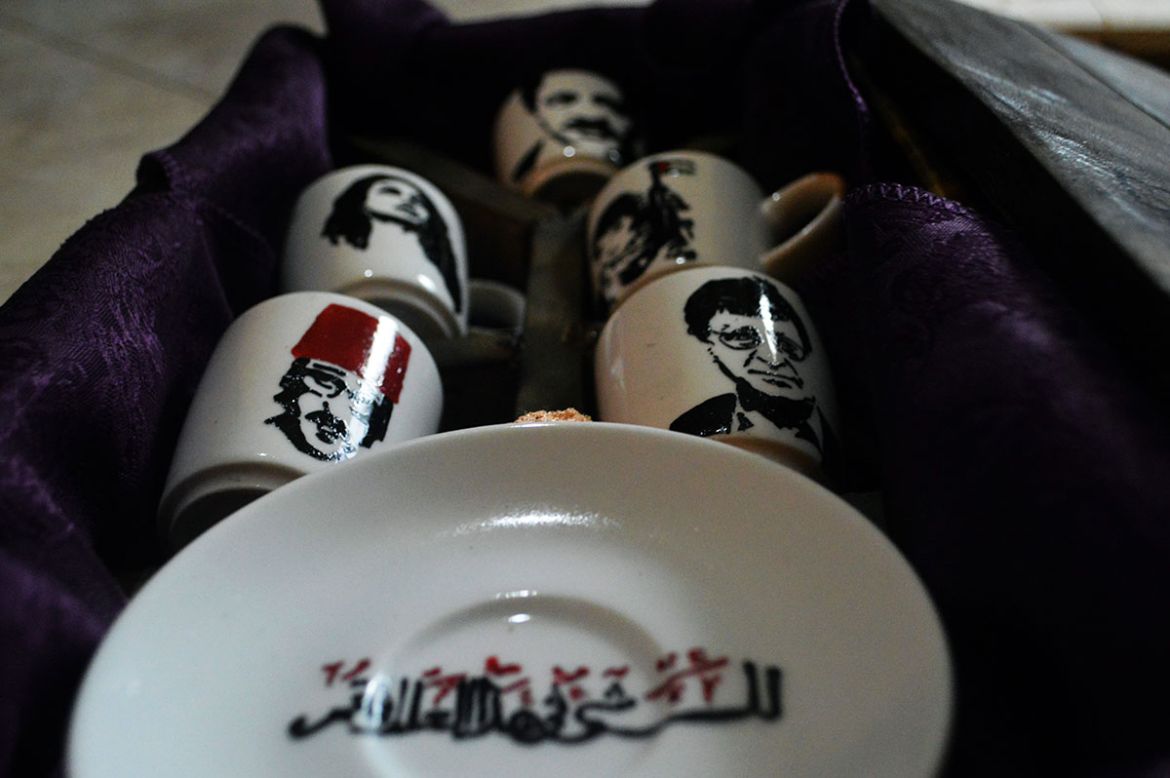
Ghassan recently began experimenting with ceramics, painting phrases, quotes and prayers on cups and plates from his home. The ceramic pieces are popular sellers on his website [Sheren Khalel/Al Jazeera]
Advertisement
Palestinian artists /Please Do Not Use
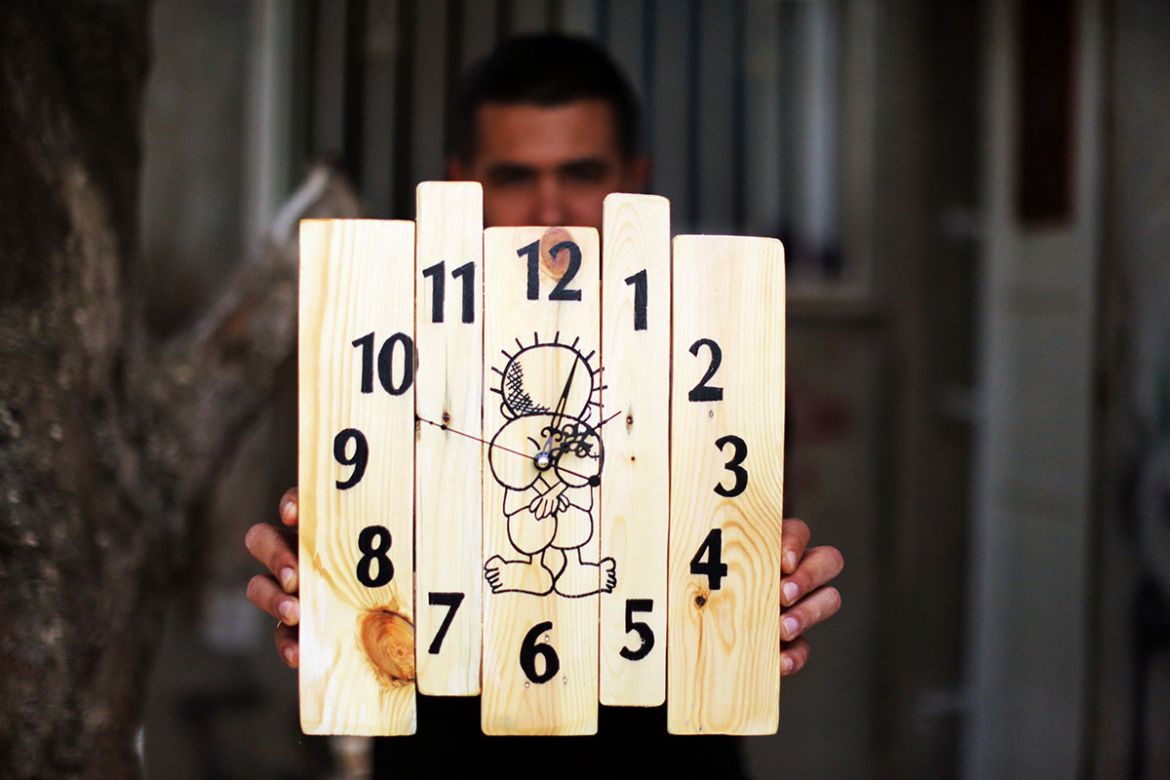
His wooden clocks were his first pieces that were not from recycled materials. The plastic and metal pieces he uses to fix the clock mechanism on to his wooden face are from local Palestinian stores [Sheren Khalel/Al Jazeera]
Palestinian artists /Please Do Not Use
Most of his work features prominent left-wing Palestinians, from authors and poets to politicians and singers, as well as famous figures from the Arab world [Sheren Khalel/Al Jazeera]
Palestinian artists /Please Do Not Use
Ghassan holds up a completed clock made from recycled wood. [Abed al Qaisi/Al Jazeera]
Palestinian artists /Please Do Not Use
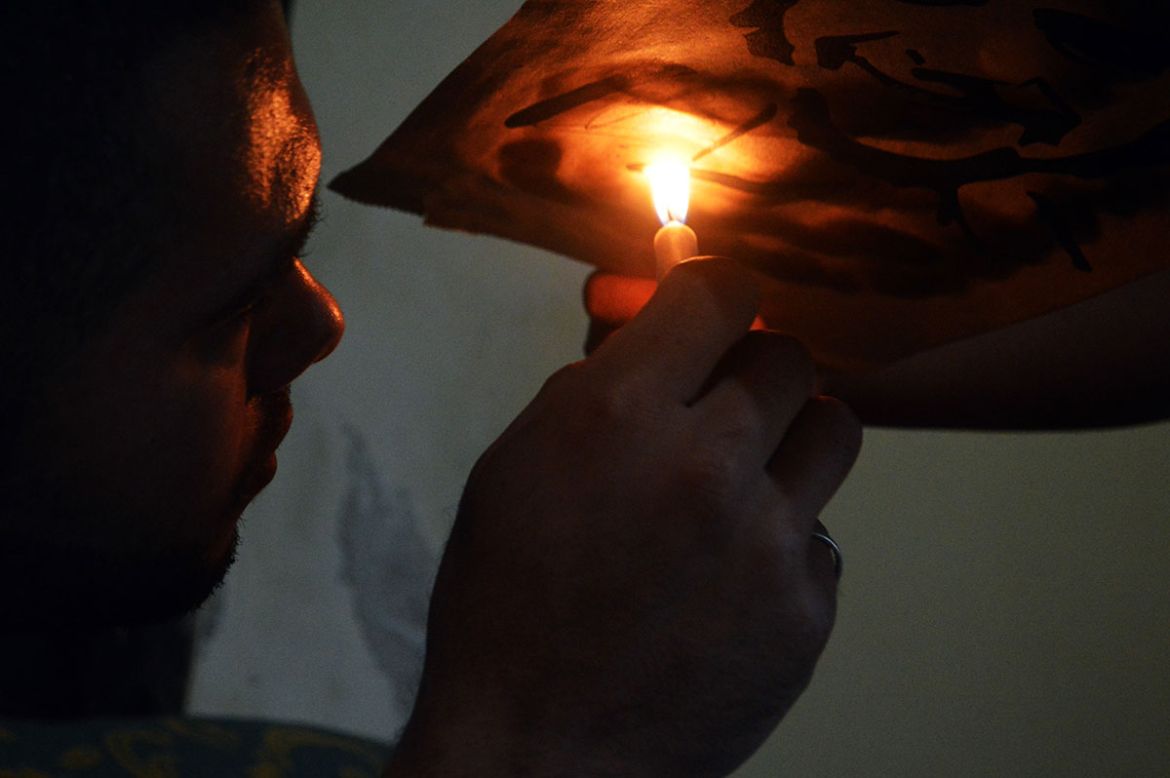
After completing a portrait, Ghassan carefully uses simple white candles to blacken brown X-Ray folders, giving them an older look with more character [Sheren Khalel/Al Jazeera]
Palestinian artists /Please Do Not Use
The prints he makes, out of recycled X-Ray folders, come in a variety of shapes and sizes [Sheren Khalel/Al Jazeera]
Advertisement
Palestinian artists /Please Do Not Use
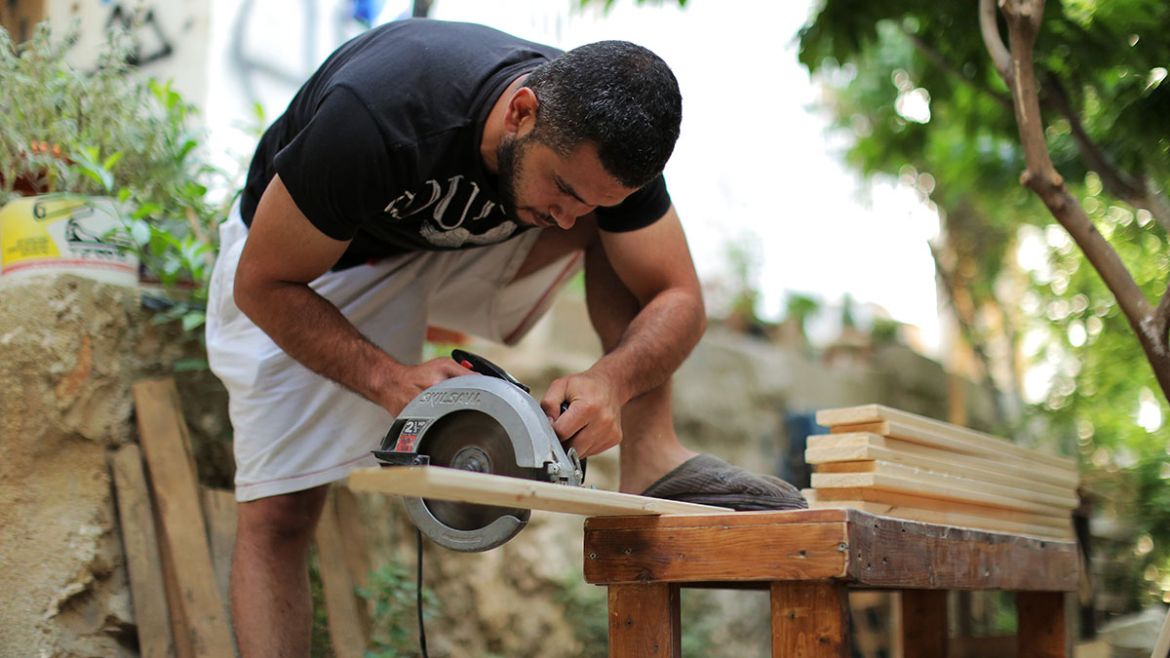
Since Ghassan was released from prison, he has moved on to larger projects using proper tools. [Abed al Qaisi/Al Jazeera]
Palestinian artists /Please Do Not Use
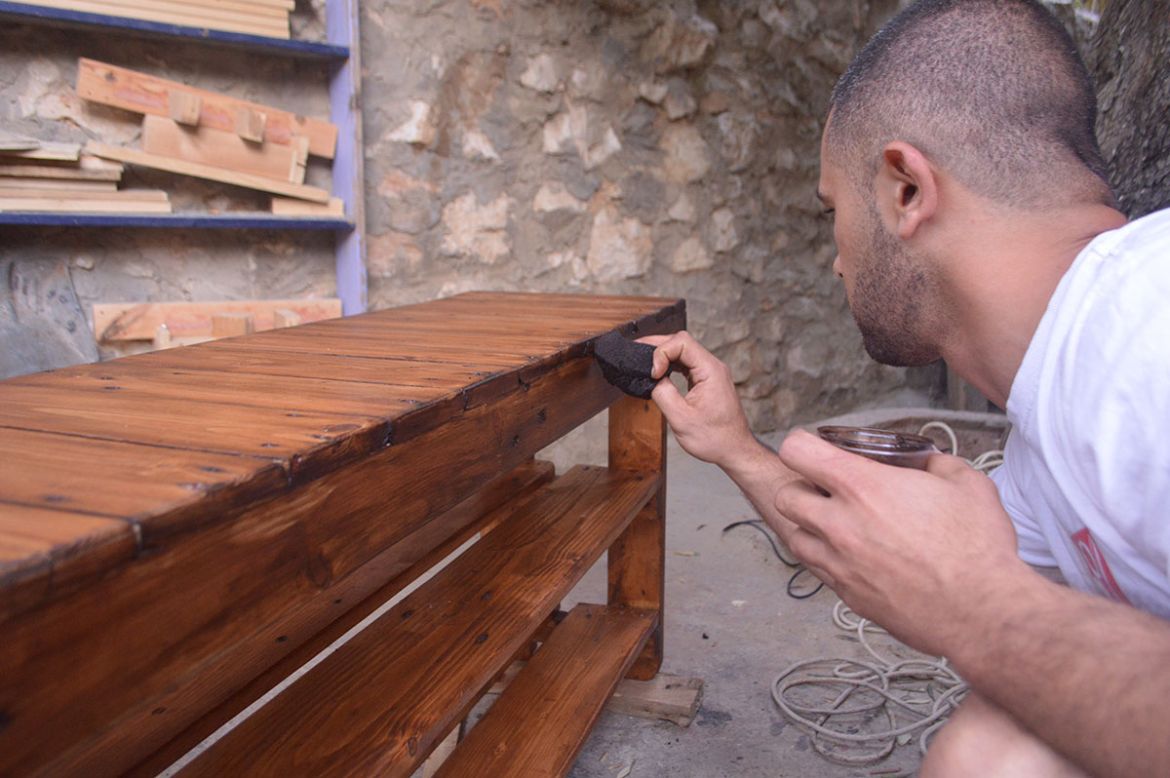
His most profitable projects are wooden furniture pieces he creates from discarded pallets, which are commissioned by word-of-mouth [Sheren Khalel/Al Jazeera]
Palestinian artists /Please Do Not Use
His workshop is cramped, and he has little room for storage or movement. While he hopes to one day have a real workshop to produce his art, he is thankful for the space. Most in the refugee camp have no land outside of their immediate home [Sheren Khalel/Al Jazeera]

Related

  • ‘Take up space’: Young models on mission to showcase South Sudanese talent

    Longing to stride down international runways often collides with reality of conservatism and lack of structural support.

    Published On 17 Apr 202617 Apr 2026
    South sudan models
  • ‘Vengeance for all’: How Iran’s Lego videos won narrative war against Trump

    The viral videos by Iranian creators, say analysts, are high-quality though cheap, and hit fissures in US politics.

    Published On 17 Apr 202617 Apr 2026
    Courtesy: Explosive Media social media
  • Could the US oil blockade snuff out the Cuban cigar?

    Since January, the Trump administration has blocked foreign oil to Cuba. Will the island’s cigars survive the crisis?

    Published On 15 Apr 202615 Apr 2026
    A Havana local smokes a cigar on the Malecón - the city’s waterfront area. Both domestically and abroad, Cuban cigars are becoming an increasingly rare luxury. [Euan Wallace/ Al Jazeera]
  • Nigerian artisans preserve handwoven fabric amid rising global demand

    Resisting mechanisation, Nigerian artisans uphold the authenticity of aso-oke, now a staple in global fashion markets.

    Published On 12 Apr 202612 Apr 2026
    Nigerian artisans preserve handwoven fabric amid rising global demand
    This gallery article has 14 imagescamera14

More from Gallery

  • Photos: Displaced Lebanese families return home despite Israeli attacks

    Tens of thousands return to southern Lebanon despite warnings and risks
    This gallery article has 13 imagescamera13
  • Photos: Afghan villagers turn to gold-panning to sustain livelihoods

    Afghan villagers turn to gold panning to sustain livelihoods
    This gallery article has 9 imagescamera9
  • Photos: Families across Sudan endure years of displacement, hunger, loss

    Crowd of children sits under a tree and listens to a teacher.
    This gallery article has 17 imagescamera17
  • Photos: Maradona’s childhood home becomes soup kitchen for those in need

    A woman rides a bicycle past murals depicting the late football star Diego Maradona.
    This gallery article has 11 imagescamera11

Most popular

  • Traffic again at a standstill in Hormuz after Iran fires on vessels

    Tankers anchored in the Strait of Hormuz, Saturday, April 18, 2026.
  • Trinidad and Tobago police uncover 56 bodies, mostly children, at cemetery

    FILE - Trinidad and Tobago Prime Minister Kamla Persad-Bissessar stands at the State Department in Washington, Sept. 30, 2025. (AP Photo/Mark Schiefelbein, File)
  • Iran war updates: IRGC says Hormuz closed until US blockade lifted

    People walk near an anti-U.S. billboard on a building in Tehran, Iran, April 16, 2026. REUTERS/Thaier Al-Sudani Foreign media in Iran operate under guidelines set by the Ministry of Culture and Islamic Guidance, which regulates press activity and permissions. TPX IMAGES OF THE DAY
  • Iran navy says any ship trying to pass Strait of Hormuz will be targeted

    A drone view shows the Malta-flagged tanker Agios Fanourios I, an oil tanker that sailed through the Strait of Hormuz, arriving in Iraq’s territorial waters off Basra, Iraq, April 17, 2026. REUTERS/Mohammed Aty

  • About

    • About Us
    • Code of Ethics
    • Terms and Conditions
    • EU/EEA Regulatory Notice
    • Privacy Policy
    • Cookie Policy
    • Cookie Preferences
    • Accessibility Statement
    • Sitemap
    • Work for us
  • Connect

    • Contact Us
    • User Accounts Help
    • Advertise with us
    • Stay Connected
    • Newsletters
    • Channel Finder
    • TV Schedule
    • Podcasts
    • Submit a Tip
    • Paid Partner Content
  • Our Channels

    • Al Jazeera Arabic
    • Al Jazeera English
    • Al Jazeera Investigative Unit
    • Al Jazeera Mubasher
    • Al Jazeera Documentary
    • Al Jazeera Balkans
    • AJ+
  • Our Network

    • Al Jazeera Centre for Studies
    • Al Jazeera Media Institute
    • Learn Arabic
    • Al Jazeera Centre for Public Liberties & Human Rights
    • Al Jazeera Forum
    • Al Jazeera Hotel Partners

Follow Al Jazeera English:

  • facebook
  • twitter
  • youtube
  • instagram-colored-outline
  • rss
Al Jazeera Media Network logo
© 2026 Al Jazeera Media Network

© 2026 Digital News Portal — Real-time updates from trusted sources worldwide.